
Good Reason Houston (GRH) works to ensure that every child, in every neighborhood across the Houston region, has access to high-quality public schools. In 2025, GRH set out to answer a challenging question: Why were more than half of eligible Houston children, nearly 42,000 kids, not enrolled in free public pre-K? GRH launched a study to better understand what was driving parent decision-making about whether and where to enroll their children in pre-K.
Surveying more than 900 families across 11 school districts, the report, Our Youngest Learners, Our Brightest Futures, surfaced four findings that are now driving GRH’s work.
Families want pre-K. Eighty-two percent of parents with a future pre-K-eligible child plan to enroll, and 73% already feel positive about public programs.
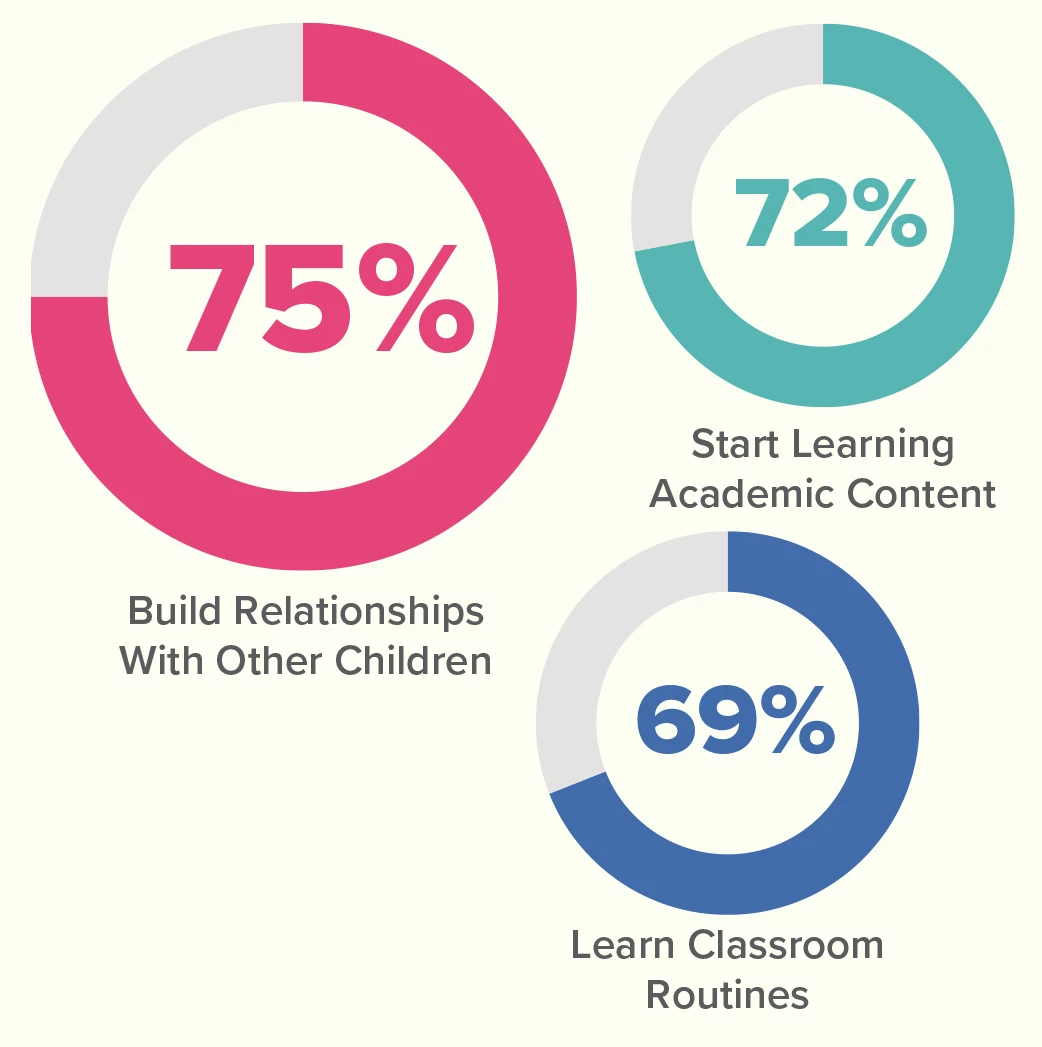
Enrollment is relational as much as academic. Families choose pre-K so children can build relationships with peers (75%), start learning academic content (72%), and learn classroom routines (69%). Meanwhile, safety concerns (25%) and simply not knowing a program exists (24%) are the top reasons families opt out.
Safety and staff training outweigh cost. Sixty-eight percent of families weigh child safety and 70% weigh teacher training when choosing a program, both ahead of cost.
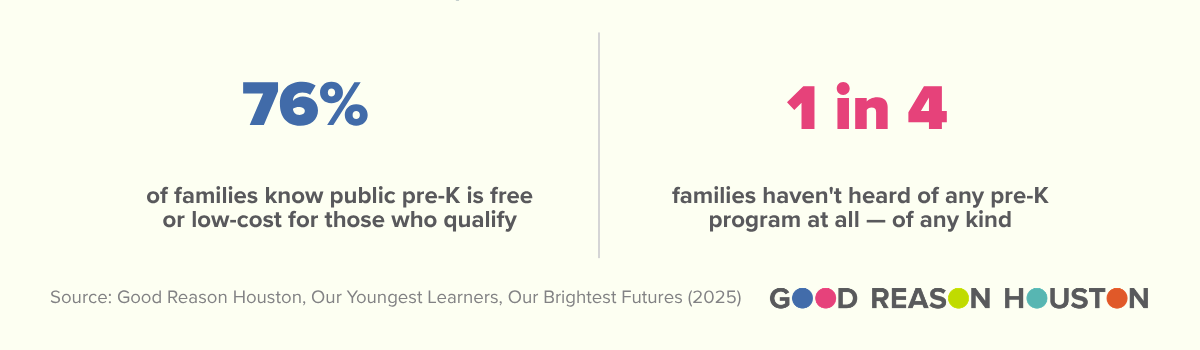
Awareness, not interest, is the real barrier. One in four families haven’t heard of any pre-K option at all, even though 76% know public pre-K is free or low-cost for those who qualify.
Why Houston Families Choose Pre-K
Top three reasons families send their children to pre-k
Source: Good Reason Houston, Our Youngest Learners, Our Brightest Futures (2025)
The Real Barrier Isn’t Interest – It’s Awareness
Families want pre-K, but many don’t know it’s available to them.
These findings didn’t sit on a shelf. They reshaped how GRH works alongside districts. With Houston ISD, GRH is sharpening marketing and targeted outreach to close the awareness gap. Across multiple districts, the findings are informing PK3 expansion. Four districts opened new PK3 classrooms this year, filling nearly every seat and enrolling roughly 600 three-year-olds who weren’t previously in public pre-K.
In Spring ISD, the findings anchor a “Data to Decision” partnership. GRH and the district co-designed a pre-K framework using CIRCLE, STAAR, and enrollment data to guide classroom observations, coaching, and resource allocation. The results make a strong case for early investment: PK3 students outpaced PK4-only peers in letter naming (71% vs. 39%), math (90% vs. 53%), and social-emotional readiness (93% vs. 75%). Pre-K attendees have also outperformed non-attendees on third-grade STAAR for four consecutive years.
Those same district lessons are shaping GRH’s policy agenda. Regionally, GRH provides input as part of the Harris County Coalition on Early Childhood Education & Care, bringing together pre-K partners and elected leaders to better integrate pre-K with child care and Head Start and strengthen quality across the system. At the state level, GRH has remained engaged on HB 2 implementation and joined LONESTARP3 members in amplifying recommendations to the Governor’s Task Force on Early Childhood Education and Care.
Heading into the 90th Legislative Session, GRH is focused on connecting those state and local conversations and using families’ own data to build the case for policies that make eligibility, cost, and access as clear as the value families already see in public pre-K.